
The Impact Edit: Stop Saying “Impact.” Start Showing Receipts.
One of the patterns I keep encountering in my work is the distance between how much effort teams put into their social sustainability programs and how little of that effort is actually documented in a way that could survive scrutiny. The programs are real. The commitments are genuine. But when the question shifts from "what do you care about" to "what can you prove," the conversation shifts.
I've started paying attention to that shift, because I think it tells us something important about where the market is heading. For years, social impact in the built environment lived in the language of commitment. "We value worker equity." "We prioritize community engagement." "We care about occupant health." These statements were accepted at face value because no one had built the infrastructure to verify them. But that era is closing faster than most teams realize. RepRisk's latest data shows that 52% of consumers now report seeing false or misleading sustainability claims, and one in three public companies linked to greenwashing is also flagged for "social washing," making vague social claims without evidence to back them.
The problem isn't the messaging. It's that nobody believes it. In tightening markets, that's the gap that actually costs you.

The market, circa now
What Standards Taught Me About Proof
When I was leading development of the WELL Building Standard, the most important thing we did wasn't defining what "healthy buildings" meant. It was defining what counted as evidence and setting thresholds for verification. That shift, from intent to measurable performance, is what turned WELL from a set of ideas into a system that now operates across 6+ billion square feet in 150+ countries.
Social sustainability needs the same structural backbone. Without it, the work stays vague, hard to compare, and easy to cut when the next budget cycle hits. With it, social performance becomes portable, something that can travel from an RFP into a procurement decision into a board presentation without losing its rigor along the way.
Three Levels of Proof
I have found that social sustainability communications stall at the first level. For claims that survive a skeptical board or a forensic audit, it helps to understand where you actually are on the ladder.
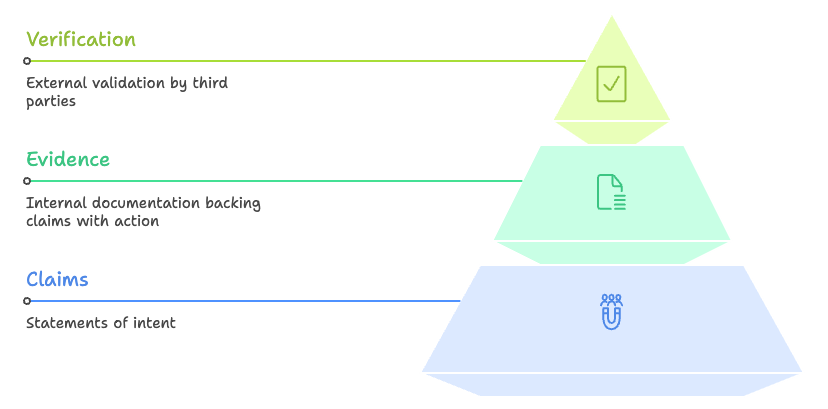
The first level is claims: statements of intent like "we are committed to worker equity." In today's market, this can be considered a form of marketing, not proof, and increasingly it's a liability.
The second level is evidence: internal documentation that shows the claim is backed by action. Wage standards, training logs, community benefit agreements, IEQ testing results, post-occupancy data. This is where most serious teams think they are, and where many of them actually need to get to.
The third level is verification: external validation that a third party can confirm. Independent audits, traceable procurement data, published resolution timelines for grievance mechanisms. This is where proof becomes an asset rather than a cost, because verified ESG performance is now measurably reducing cost of debt for companies that invest in it.
What This Looks Like in Practice
If you're an owner, developer, or green/healthy building consultant, there are a handful of indicators that separate teams operating at level two or three from those still at level one.
Audited labor standards across the project lifecycle tell you whether fair treatment is a policy or a practice, and in a market where 86% of employees want to work for companies whose values align with their own, this is as much a talent strategy as an ethics one.
Documented community engagement with a clear record of what changed because of local input tells you whether participation was performative or substantive. This is also a sophisticated risk strategy: projects that move at the speed of trust tend to encounter fewer permitting delays and less litigation.
Verified indoor environmental quality data and post-occupancy evaluations tell you whether health claims are backed by measurement. With wellness real estate now one of the fastest-growing segments of a $6.8 trillion global wellness economy, tenants and buyers are starting to demand this.
Transparent grievance mechanisms with published resolution timelines tell you whether a team responds to harm or hides from it. And tiered procurement traceability, chain-of-custody records and supplier disclosures for high-risk materials, tells you whether "we didn't know" is still the supply chain strategy, in a world where 50 million people are estimated to be in modern slavery.
None of these are radical. All of them are measurable. And together, they represent the difference between claiming social impact and being able to prove it under pressure.
The Window Is Shifting
The market is moving from "tell me your values" to "show me your evidence," and the teams that build their proof infrastructure now will have a significant advantage over those that wait for regulation or client pressure to force the issue.
I've put together a one-page Social Sustainability Proof Checklist that you can drop directly into your next RFI, RFP, or vendor review. If you'd like a copy, send me a message and I'll get it to you.
The Conversation Continues...
This post is part of our ongoing exploration into how to move beyond vague commitments and build the rigorous, verifiable infrastructure needed to prove your social impact. As problem-solvers, we believe the best insights emerge when diverse perspectives meet. Have you encountered similar challenges or discovered different approaches? Share your story.
Connect with us as we continue to prototype, test, and learn:
Subscribe to our newsletter
Join us on Linkedin
Explore our resources
We acknowledge that social sustainability is always a work in progress. These insights represent our current understanding, shaped by our partners, communities, and continuous learning.