
The Catch-22 of Stepping Away From AI
Changing Tomorrow Season 2 Episode 3: Opting Out of AI Is Not Neutral
This article is a digest of our podcast conversation with Zainab Garba-Sani, Founder & Executive Director, ACCESS AI / Senior Harkness Fellow, Stanford University, exploring what happens to equity, representation, and systemic trust when communities choose to step back from an increasingly automated world.
🎧 Stream the full conversation:
📄 Get our report: Read Liveable’s Spring 2026 Brief: AI Accountability in the Built Environment
When it comes to AI, the conversation usually splits into two extreme camps. On one side, tech enthusiasts tell us we have to embrace it immediately for maximum efficiency. On the other, critics argue that the only ethical choice is to refuse it entirely.
But Zainab makes a much more interesting, nuanced point: opting out of AI is actually dangerous.
Here’s why: AI runs on data. If a community chooses to step away and refuse to participate, the technology doesn’t just stop moving—it keeps evolving without them. Because that community isn't seen in the data, the resulting algorithms become deeply biased and inaccurate.
In healthcare, being left out of the data isn't just an inconvenience; it can be fatal. For example, when an AI tool designed to spot skin cancer is trained entirely on pictures of white skin, it fails to recognize the disease on darker skin tones. It’s not that the AI hates anyone; it just wasn't taught to see them.
The Ghost of Medicine Past
Why are people skeptical about handing over their data in the first place? It comes down to a massive, historically justified trust deficit. For generations, marginalized communities have been burned by systemic exploitation.
Take the famous story of Henrietta Lacks. In the 1951, doctors took her cells during her cancer treatment. Without her knowledge or consent, those cells (HeLa) were used to build the foundation of modern medicine—helping create everything from IVF treatments to cancer drugs. Trillions of dollars of value were generated, yet Henrietta and her family were never compensated, and her community still faces massive health inequalities today.
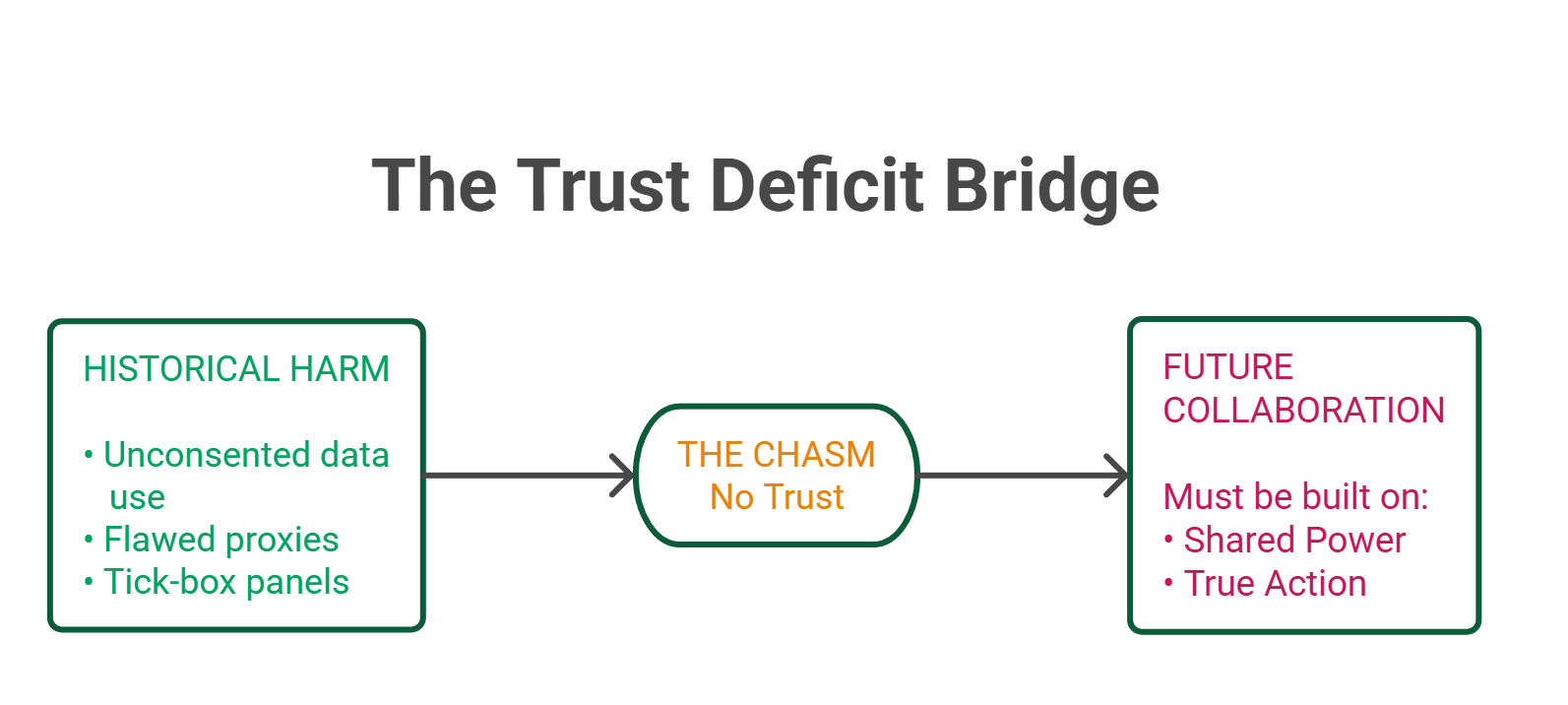
So when a tech company showing up today asks for a community's data to train an algorithm, they aren't starting with a blank slate. They are stepping into a long history of broken trust. True engagement can't happen until institutions realize they have to earn that trust back through real action, not just slick PR.
When Math Mimics Bias
We like to think of computers as cold, objective, and perfectly neutral. But code doesn't write itself, and algorithms are only as good as the math we feed them. When engineers can't measure something directly, they use a "proxy"—a stand-in metric. If that proxy is flawed, the AI automates our worst human biases at lightning speed.
A clear example of this happened in a major AI tool used in the US to prioritize patients for extra medical care. Instead of looking at how sick a person actually was, the algorithm used a financial proxy: historical healthcare spending. The computer assumed that whoever had the most money spent on them in the past must be the sickest.
But it completely ignored systemic realities. Because Black and lower-income populations historically have had less access to healthcare and less money spent on their treatment, the AI completely misread the room. It automatically funneled extra care to wealthier, healthier white patients, while pushing the sickest people to the back of the line. And because it happened silently behind the scenes, no one even knew it was happening.
Ditching the "Tick-Box" Mentality
If we want "People Positive AI," we have to completely change how organizations interact with the public. Right now, "community engagement" is usually a superficial, tick-box compliance exercise. A company brings in three self-selected representatives, tells them what they're going to build, notes that no one had immediate technical objections, and calls it a day.
That is lazy, and it’s dangerous. True, responsible engagement looks completely different:
Lighten the Load:The people whose voices we need most are often the busiest. They have jobs, families, and health needs. Expecting them to jump through administrative hoops for free is a failure of design. We have to make it effortless for them to speak to us.
Invest in Context:You can't ask someone for feedback on a complex AI system if they don't know how it works. We need to invest time and resources into demystifying the technology before we ask for data.
Share Real Power: Listening is only half the battle. If a community flags an issue, they need to have the institutional power to actually change how that tool is built or deployed. Actions speak louder than words.
Ultimately, technology is a magnificent tool, but it cannot replace human empathy and sharp intuition. The future isn't about letting a runaway algorithm steer the ship; it’s about learning how to govern it together
Listen to the entire episode:
Read the report: Liveable's Spring 2026 brief, Automated Decisions, Human Consequences
Take Action
At Liveable, we help organizations evaluate the impact of the choices they are already making.
Our People Positive™ Snapshot uses a practical social value lens to review your policies, projects, products, or business—identifying what’s working, where friction lies, and how better strategy can drive stronger outcomes. It’s built for teams that want a clear starting point, not a months-long audit.
👉 Create your People Positive™ Snapshot