
Creativity, Wings, and AI in the Loop
Changing Tomorrow Season 2 Episode 4: Cultivating Authentic Human Perspective in the Age of AI
This article is a digest of our podcast conversation with Archita Mandal, filmmaker and CEO of UpendNow, exploring what happens to human voice, perspective, and storytelling when machines learn to generate art.
🎧 Stream the full conversation:
📄 Get our report: Read Liveable’s Spring 2026 Brief: AI Accountability in the Built Environment
Flipping the Loop
When people talk about artificial intelligence and the arts, a wave of anxiety usually follows. We see headlines about shrinking workforces, and creators worry that automated systems will completely flush out human expression.
But Archita looks at the entire framework differently. In tech circles, people constantly use the phrase "human in the loop" to describe keeping a human around to double-check an end-to-end AI process. Archita argues we have it completely backward: it should be AI in the loop.
Humans are the orchestrators, the directors, and the ultimate creatives. AI is simply a highly responsive tool sitting inside a sandbox that we control. It handles the tedious, time-consuming administrative weight of pre-production, leaving the human free to focus entirely on the deep psychology of a story.
Giving Wings to Indie Creators
The most profound asset of creative AI isn’t automation; it’s democratization. Filmmaking has traditionally been a highly gatekept, incredibly expensive industry. If you are an independent filmmaker running on a shoestring budget, you simply cannot afford a professional storyboard artist or massive visual effects (VFX) teams.
AI tools are changing that reality by leveling the playing field. It gives indie creators access to complex workflows that were previously locked away behind massive studio budgets.
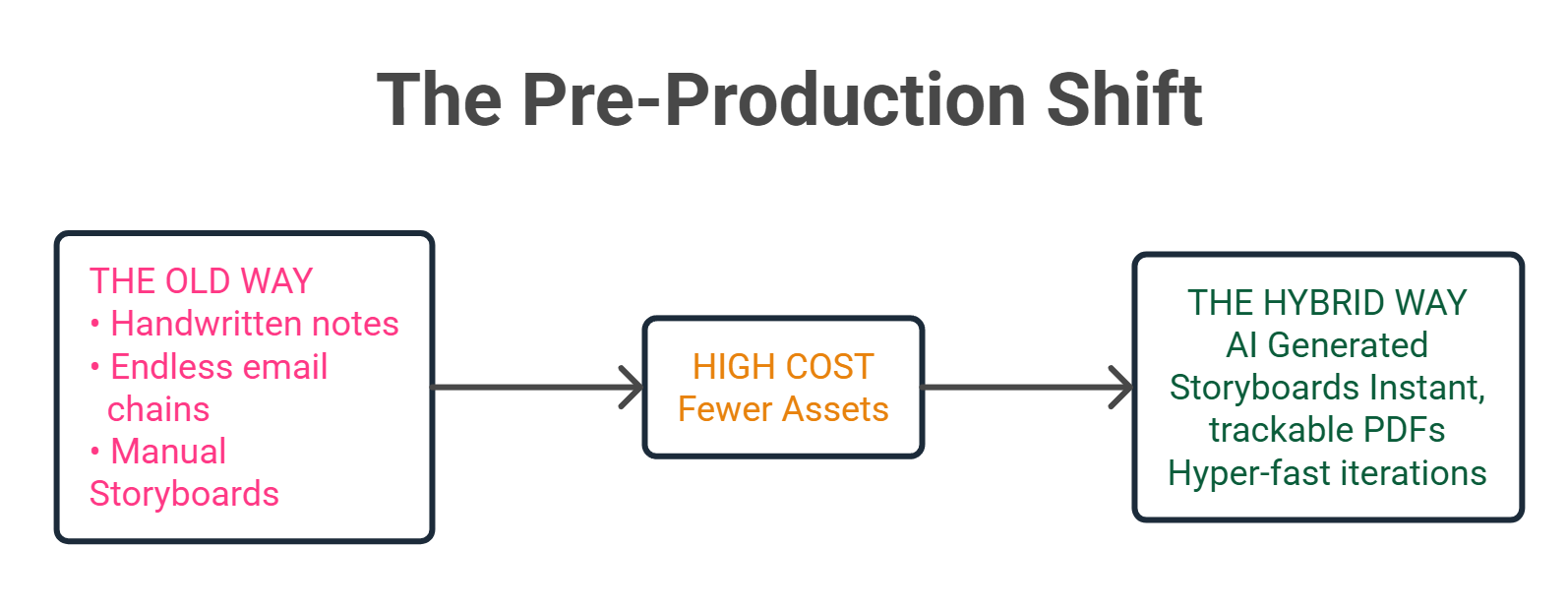
Archita experienced this firsthand while directing her award-winning horror satire short film, Ominous. While it was a 99% live production featuring real actors, she used AI as a "gap filler" to smooth out transitions and capture missing elements. When the crew ran out of time for a physical drone shot, AI generated it. When she needed to communicate a visual concept to her art and costume departments, she swapped tedious handwritten emails for instantly generated storyboards. The technology gave her ideas wings without compromising her live-action vision.
Why Math Can't Borrow Your Perspective
Can a machine ever truly replace a human creative? The short answer is no, because AI lacks perspective.
Two people can share the exact same city, demographic background, and cultural roots, yet their lived experiences will give them entirely different viewpoints. An algorithm cannot simulate that unique human baseline. It can generate a technically pristine image or a structurally logical block of text, but without a human driving the wheel, the output is just hollow "AI slop."
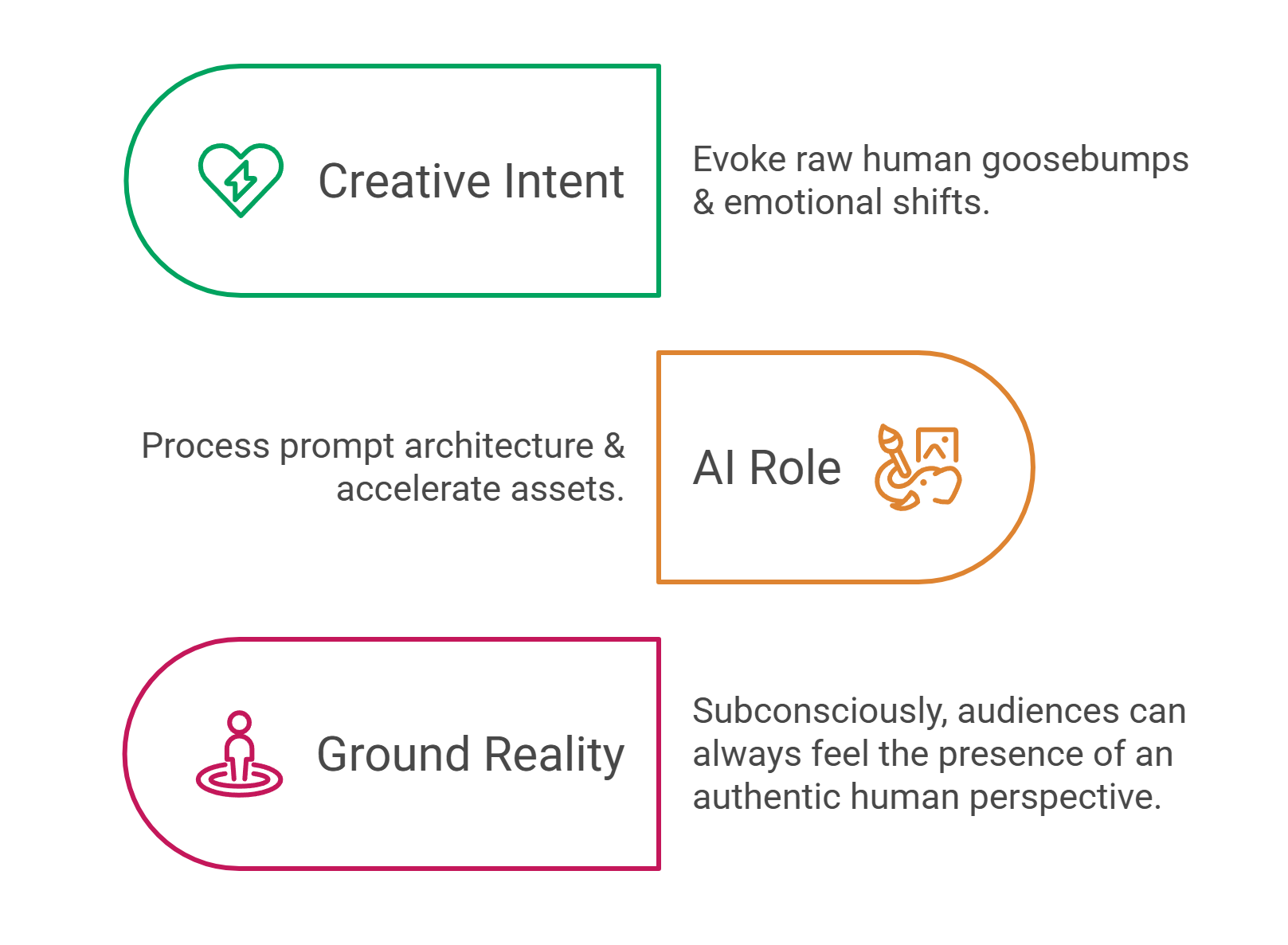
True storytelling requires pulling real emotions out of another human being. A computer model can perfectly memorize historical formatting, but it doesn't know what it feels like to be haunted, to laugh, or to navigate a physical neighborhood. When content hits you deeply, it’s because a human storyteller orchestrated the machine to invoke that specific feeling. To tell a moving story today, you still fundamentally have to be a storyteller.
Designing for an Intentional Future
If we want a "People Positive" future for creativity, we have to move away from mindless deployment and move toward conscious, trackable guardrails. We are already seeing positive steps in this direction, such as the digital rights guidance emerging from unions like SAG-AFTRA.
True progress means knowing exactly how your tools operate and protecting creative ownership. This is why initiatives like the C2PA (Content Authenticity Initiative)—backed by giants like Adobe, Microsoft, and Google—are so vital. By embedding secure, trackable metadata directly into digital assets, C2PA makes authorship transparent.
When you use a platform that respects these standards, every storyboard or visual generation is meta-tagged, letting the internet know exactly who created it and what tools were used. It ensures that technology acts as a supportive conduit for our imagination, tracking our digital footprint so that real artists are rewarded and protected, rather than crushed.
Listen to the entire episode:
Read the report: Liveable's Spring 2026 brief, Automated Decisions, Human Consequences
Take Action
At Liveable, we help organizations evaluate the impact of the choices they are already making.
Our People Positive™ Snapshot uses a practical social value lens to review your policies, projects, products, or business—identifying what’s working, where friction lies, and how better strategy can drive stronger outcomes. It’s built for teams that want a clear starting point, not a months-long audit.
👉 Create your People Positive™ Snapshot